
1985 vs. 2025: A Post-Pandemic Retrospective

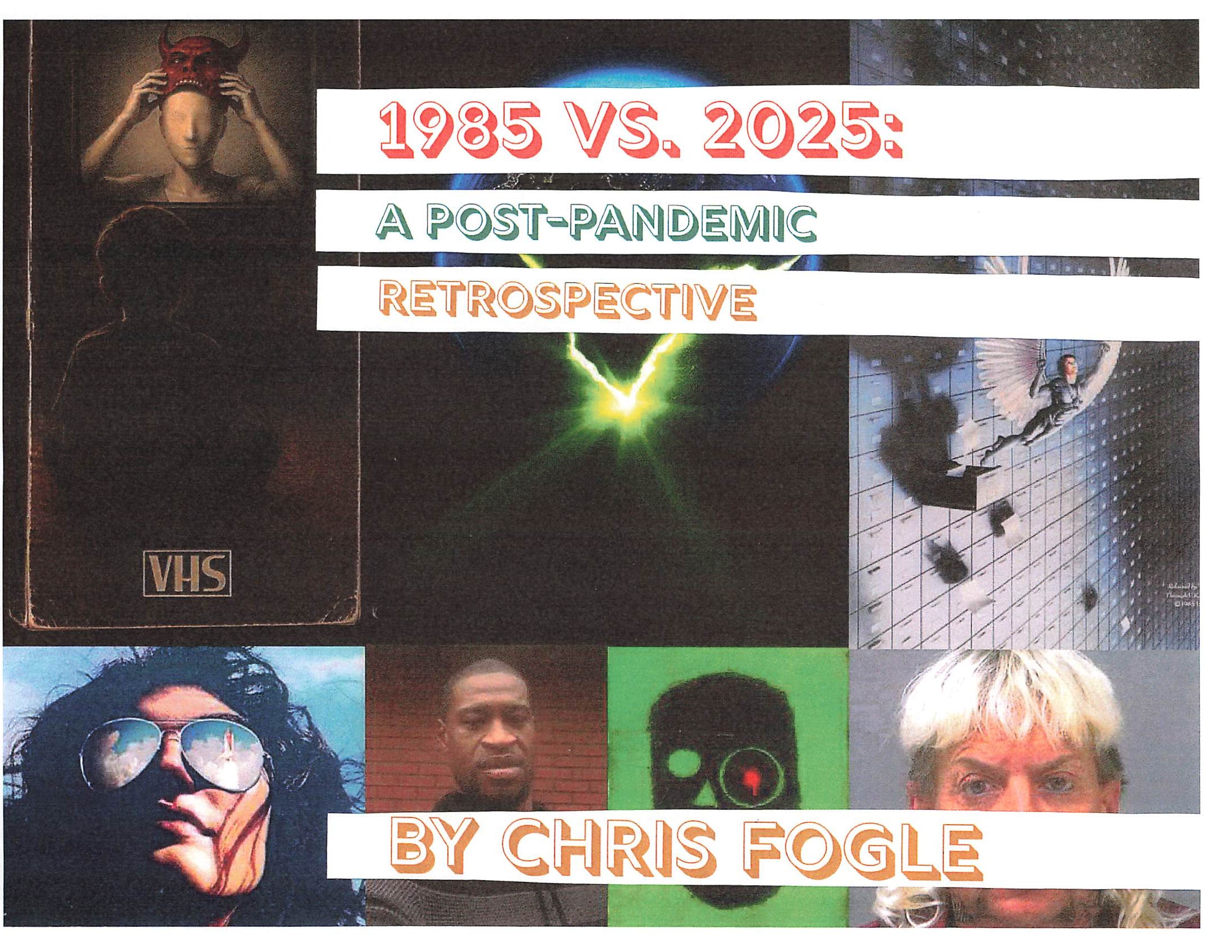
Every year I publish a 1980s vs. the current year article and every following July I give you an exclusive article of content that was cut for length. This year’s exclusive is specifically based off the article “1985 vs. 2025: A Hope/less Hallelujah.”
Today we’ll cover three effects of the Satanic Panic and how the pandemic of 2020 has impacted us five years later. I tried to make it boring but entertaining media like Daredevil, Brazil, Final Offer, Alien: Earth, Back to the Future, The Toxic Avenger (and many more) kept popping up. Don’t worry, for those seeking more serious, practical discussions, we’re also covering George Floyd, corporate greed, and tough questions like whether God lets innocent people suffer.
Good stuff all around, but we are talking about the pandemic so sit back, relax, and employ the soap.
Satanic Panic: Three Effects on the United States of Hysteria
I wrote at length about 1985’s influence on the Satanic Panic in the original article but didn’t have time to cover three important nuances: conspiracy theories, misogyny, and mental health.
Satanic Panic: The Gateway for Right-Wing Conspiracies
In 1983 one (mentally unstable) parent accused McMartin Preschool of child abuse. By 1984, hundreds of families levied accusations, which had graduated into supposed satanic ritual abuse with teachers flying around rooms and hidden caverns under the school. According to sociologist Mary de Young, “This was a snail mail approach to spreading a moral panic.”
But as the authors[i] of “America’s Satanic Panic Returns — This Time Through QAnon” point out, “By contrast, the early rise of QAnon was entirely digital. In November 2017, an anonymous user named ‘Q Clearance Patriot’ posted for the first time on the message board 4chan. An NBC News investigation later found that three other users initially promoted and spread those early posts, beginning the transformation of QAnon from an obscure online forum to an influential conspiracy theory taking root in far-right American politics.”
This summary of QAnon doesn’t mention any religious roots, so was it really like the ’80s? The article’s writers continue: “As QAnon spread, so did the belief among its adherents that a Satan-worshipping cabal of elite politicians was ritually abusing children — and, specifically, draining them of a chemical compound called adrenochrome, which they believe is then ingested as a drug.”
Alright, Satan worship? Check. So are the moral panics identical? No, there are differences “between QAnon and the Satanic Panic of the ’80s, the biggest being the political nature of QAnon conspiracy theories, which target Democratic politicians and hold up former President Donald Trump as a savior.”
And this is important. Whether they consider themselves religious or not, if someone is part of MAGA, they belong to the cult of Trump. Several groups groomed the United States for this idolatrous worship in the ’80s (I mentioned multiple factors in the original 1985 vs. 2025 article).
For our purposes, in 2020, coming out of four years under our lord and savior Donald Trump, the pandemic helped galvanize QAnon to greater power. Mike Rothschild, author of the 2021 book The Storm is Upon Us: How QAnon Became a Movement, Cult, and Conspiracy Theory of Everything explains how conspiracy theorists viewed the pandemic:
“[Everything was] filtered through the lens of this wasn’t just a once in a century pandemic that was exacerbated by certain political failures.
[Instead, it must have been] an attack. This was an attack by the elites, by the globalists, and we need to get with the people who are helping us fight back. And that turns into the wellness influencers, that turns into the conservative politicians, that turns into the anti-vaxxers.
Because now suddenly you have an outlet for your anger, and somebody who can harness that and try to do some good with it. So I think so much of where we have landed in the last year and a half or two years, is the sort of hangover from that post-COVID anger, boredom and fear.”[ii]
I found Rothchild’s analysis both fascinating and compelling. Our nation is bathed in combat rhetoric - esteeming aggression and mocking compassion - which desensitizes and subliminally assumes everything has an ulterior motive, everything is an attack on our freedoms and rights. (The pandemic taught us even toilet paper can be weaponized…and if I’ve learned anything in the past five years, it’s that bathroom humor stinks.)
But who decides what rights and freedoms are allowable? Conspiracy theories can clearly harm people even if that’s not specifically part of the paranoia plan. A despicable example comes from the Satanic Panic, which might be spun as “feminism,” but was simply the inequality of misogyny.
Satanic Panic: Moral Misogyny
In a section titled “Hope in the Present: Can There Be Biblical ‘Feminism’?” I explored misogyny’s role in culture and the Church. Doctor Laura Robinson is a New Testament scholar at Butler University and speaks on complex issues that affect the public. On the subject of the Satanic Panic’s effect on women, and especially society’s views of mothers, Dr. Robinson says:
“In the 1980s, we suddenly had a lot more women entering the workforce during their children’s young childhood, right? And [they] were dropping their kids off at daycares. [Because of people like] Phil Schlafly in the Moral Majority, there was a ton of anxiety about women being in the workforce. There’s a lot of contempt for women who would drop their kids off at daycare. And I think that part of the way this manifested was this need to justify the contempt we had for working women.
So why should we think that women who work and send their kids to daycares are bad mothers? Well, because the daycares are all run by Satanists, right? It can’t be that we’re sexist.
It can’t be that we actually don’t want women to be financially independent. It can’t be that we’re uncomfortable with women in the C-suite. It’s because the daycares are run by Satanists, right? Like, I think that’s where a lot of this comes from.”[iii]
I can’t tell what I love more: Robinson’s common-sense analysis, or that she does it with professional sassiness!
Although I don’t believe there was a grand design to the Satanic Panic, it was a Petri dish for moral mania. Well-intentioned beliefs (especially the Church’s convictions) informed and shaped the Panic’s direction.
In his review of CT Media’s podcast “Devil and the Deep Blue Sea,” Jason Morehead summarizes one of the major lessons to learn from the Panic, saying, “[It’s] a potent reminder (for Christians, especially) that the more obsessed we become with perceived evils ‘out there,’ the blinder we’ll become to the very real evils in our own midst.”
Considering all the casualties of the Satanic Panic, possibly the greatest will never be known: actual victims. Those molested without a splashy Satanist story, those abused but never investigated because law-enforcement was swamped with (ultimately) false claims, and societal expectation for victims and abusers.
Society and law enforcement were hunting preschool teachers and teenagers listening to heavy metal while playing D&D, not the real abusers – who are typically men known by the victims. Consider these current statistics:
“1 in 4 women…across the USA have been victims of rape or attempted rape.”[iv]
No, you didn’t read that incorrectly – 1 in 4 women have been victims or attempted victims of rape! I first learned this statistic in 2025, and it shook me to my core. The last thing I want to do is fearmonger – although that 1 in 4 stat is higher since an estimated 65-80% of rapes go unreported.[v] But being informed is the first step in prevention. And recognizing that the effects continue long into the future is important too:
“81% of women who experienced rape, stalking or physical violence by an intimate partner reported [impacts], such as being fearful, PTSD symptoms and injury, while 35% of men report such impacts of their experiences.”[vi]
That last statistic is the (unfortunately) perfect segue into our next section. So I must ask: Do we consider the psychological impact of abuse and victim-blaming on mental health recovery?

Satanic Panic: Mental Health & Reginald VelJohnson
Common threads from the ’80s Satanic Panic origins that don’t get a lot of publicity are mental health issues (Michelle Smith, Judy Johnson, Lauren Stratford, etc.). It appears that the public wanted so badly to believe Satan had a grip on our country, especially the youth, that they didn’t check to see if the victims indirectly inciting a nationwide panic were getting the care they needed.
And yet, as Mike Cosper points out, mental health language wasn’t known by the public in the ’80s. Looking back, ConfusedBreakfast has an incredible theory where Reginald VelJohnson deals with Ghostbusters’s paranormal events by moving to L.A. becoming involved in Die Hard events, where he has a mental break and creates a fabricated reality seen in Family Matters! That theory could only come from a mid-2020’s worldview, deeply immersed in the past.
As we consider our penchant for remembering the past – whether out of curiosity or nostalgia or a “doomed-to-repeat-it” aversion –we’ll now turn our eyes toward the last five years. When I first pitched this series idea of celebrating each forty-year anniversary with a comparison between the 2020’s year and 1980’s year, I (obviously) had no idea we were in for a global pandemic. My article “1981 vs. 2021: Searching for Salvation” serves as an interesting time capsule for the start of this era. With no further ado’s given, what changed over the last five years?
2020 Retrospective: Five Years After the Pandemic
My themes for last year’s 1985 vs. 2025 were hope and hopelessness. Consequently, many of my considerations for these cultural moments reflect those subjects.
A Post-Pandemic Hangover: George Floyd and Renée Good
Twenty-twenty is primarily remembered for the pandemic (and we’ll cover it) but an event in May of that year must be viewed through the context of the pandemic. The murder of George Floyd sent shockwaves around the world. Demonstrators protested police brutality and racial injustice in the midst of quarantine. At a base level the question had to be asked: regardless of what Floyd was guilty of, did he, as a human being, deserve to die?
Floyd was murdered in Minnesota but I personally saw murals for him in Nashville and Houston. His death effected millions of people and it continues to be some sort of warning for those paying attention.
As immigration policies heated up under Donald Trump toward the end of 2025, Renée Good was murdered by ICE (Immigration and Customs Enforcement) agent Jonathan Ross.[vii] Michael Barbaro interviewed Minneapolis’ police chief, Brian O’Hara, noting the chief had “been warning about this for weeks. More than five years ago, the killing of George Floyd by members of his department tore Minneapolis apart. O’Hara came in afterward to rebuild the force and re-establish trust with the city’s residents.”
Barbaro “asked what [O’Hara’s] first thought had been when he heard about the Good shooting. O’Hara was measured throughout the interview, and you can hear the pause as he considers the question. ‘I just thought, F###, this is it,’ O’Hara said. ‘You know? This is potentially 2020 all over again.’ ‘George Floyd all over again?’ Michael asked. ‘The destruction of the city,’ the chief responded.”[viii]
Where can we find hope when we feel (rightfully) enraged over murders like those of George Floyd and Renée Good? You know, like serving some of Mary Poppins’ medicine if she was Malcolm X.
There are no easy answers, in fact, to give them would be condescending, disgraceful, and egotistical. After all, this isn’t a new problem – human history has been bathed in bloodshed and wrongful accusations.
Certainly every time the Satanic Panic accused an innocent person of molesting children or murdering babies, their lives were forever detrimentally impacted. Naturally, age-old questions like Why does God let the innocent suffer? and Is God punishing people? surface.
Welcoming Church: Hell Town’s Daredevils or Father Brown’s Service with a Smile
To make sense of these questions, it can be helpful to honestly assess ourselves. Director Rian Johnson has been explicit that his Knives Out series is meant to draw attention to each release’s exact cultural moment.
Twenty-twenty-two’s Glass Onion shows how two groups of people handled the pandemic: obeying rules (like wearing masks, social distancing, and quarantining) versus the angry rebels. I wrote this article during the pandemic asking people not to flex their freedom but to assert their love.
Johnson’s Wake Up Dead Man shows how two groups of people handle Christianity in 2025: focused on God’s wrath and justice, versus focused on Jesus’ love and mercy. Are we meant to punish, or be punished, or neither?
In Ahmed and Kuder’s Daredevil, Volume 3: Living Hell, when Daredevil’s seven deadly sins manifest as demons, he believes God is punishing him. But after Elektra’s secular perspective and a priest’s spiritual wisdom both conclude God isn’t torturing him, Daredevil is relieved, saying, “Hearing you sound so sure almost gives me hope…” Both Murdock and his alter ego Daredevil have many difficulties weighing on them. When overwhelmed by problems and, like Daredevil, feel God has abandoned us, we can lose hope.
True to what I wrote about Zohran Mamdani’s intentional use of “hope” and “despair” in his run for New York City Mayor, “Emma Goldberg and Benjamin Oreskes explained…‘The Mamdani campaign gave a lonely generation something to bond over. “Addicted to their screens, strapped for cash, spiritually unmoored and socially stunted by the pandemic, young New Yorkers needed a reason to get out of the house. They found it in Zohran Mamdani’s mayoral run…’”
It’s nice that the bodega-born found hope in a politician, but that description of “spiritually unmoored” gives me pause. It’s natural for us to expect leaders to guide and direct.
Hell Town was a 1985 show about a tough ex-criminal turned priest ministering to L.A. (no, not “Louisiana’s” gang-ridden, drug-addled mean streets, but “Los Angeles”). We’ve seen this motif in Preacher and Gideon Falls and Soulfinder (okay, so it’s mostly graphic novels). But what if someone like Father Brown is simply what people need in their real lives at a fundamental level?
There have been multiple shows and films with the parish detective, but what probably registers most with modern viewers is the current series starring Mark Williams. Still going strong after thirteen seasons, the show is based on G.K. Chesterton’s book series. But why has the concept remained popular for a century?
I think, like Murdock’s Daredevil, we need a practical priest. The theologian with no real-world experience is as useless as the tough-as-nails pastor with no spiritual guidance. But there is an onus on the average Christian too. As we’re poured into by this practical priest, we must recognize this is also equipping us to join Christian community and to serve others.
Back in 1985, Pastor Darrell Robinson had some ideas on how the Church should behave. His opening words to the book Total Church Life are: “The greatest need in our time is a first-century church in a twentieth-century world.” His explanation of early church basics includes a rebuttal to the excuse that people can worship God from their home or in nature. Apparently 1985 saw the same avoidance of in-person meeting as the early and mid-2020’s saw (heightened by the pandemic).
Robinson agrees, God can be worshipped privately anywhere, but to refrain from attending church is to ignore the whole Bible’s example of corporate worship. Not to mention Jesus, Paul and other New Testament writer’s commands to meet together and to impact the local community together for Jesus. “The church gathers for strengthening, scatters for service.”[ix]
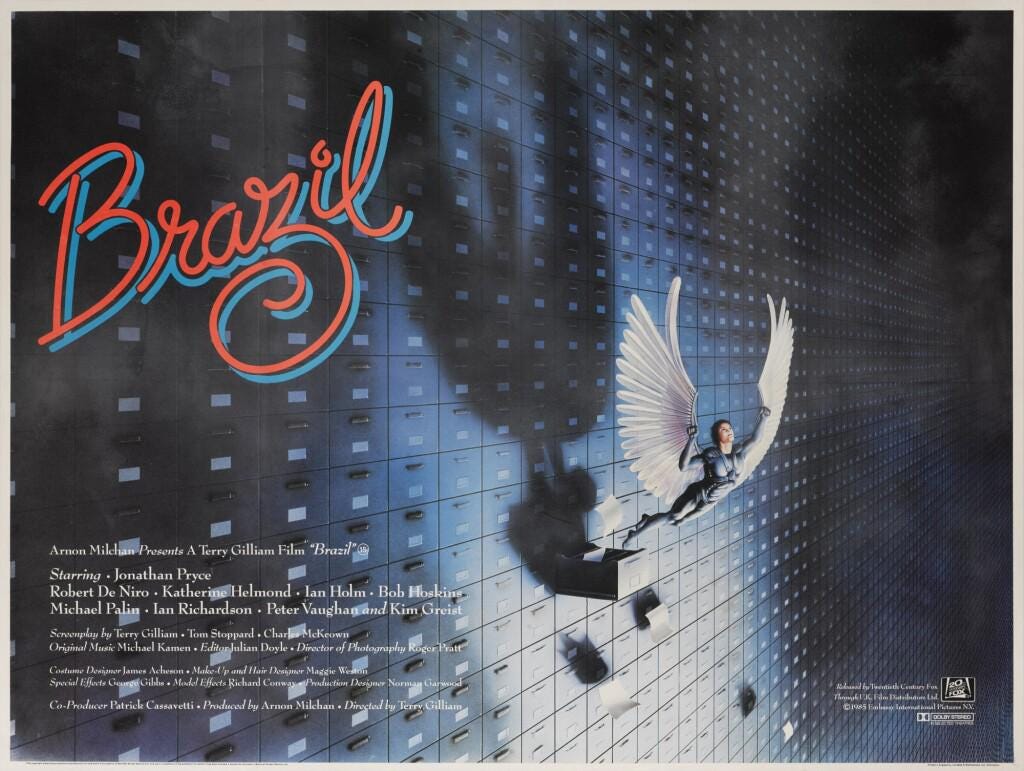
I love that idea of scattering to serve. And a revealing litmus test for this love versus apathy is found in the beautifully bizarre Brazil.
Con(Men)glomeration: Brazil Bureaucracy & Corporate Greed
Talking about director Terry Gilliam’s Brazil (1985), Instagram user itsjustcinema said,
“Everyone in the film is so aggressively committed to acting normal…and all the [Christmas] festivities just become this sort of flimsy wallpaper over a world that is just so obviously broken. And it’s actually really funny until you realize how close we’ve actually come as a society to acting in the exact same way. Like, [do Americans care] what else is going on in the world?”
Brazil underscores the insanity, indifference, and inefficiency of corporate bureaucracy. Speaking on conglomerations in 2025, Alex McCann said, “The corporate role isn’t dying in some dramatic collapse. It’s dying like religion died for many people — slowly, through diminishing belief rather than disappearing churches. The structures remain. The offices still gleam. The meetings still happen. The emails still flow. But the faith that this activity means something, that it’s building towards something worthwhile, that it justifies the life hours it consumes — that faith is evaporating.”
The Alien franchise has never trusted corporations (*cough* Weyland-Yutani - who shall not be named…well, until Alien3) but 2025’s Alien: Earth is combative in its caution. Since being announced in 2020, creator Noah Hawley honed the series’ development into a warning: corporations steal innocence by pursuing their own interests.
Growing up I’d always heard how greedy and soul-sucking corporations were. Then I started working for one in my early twenties and it was pretty great. My operating company had all the benefits of an international organization plus the freedom to make independent decisions on what worked best for us.
But as the pandemic of 2020 wore on, the landscape shifted. And over the last five years, my experiences and work-life balance and engagement have declined. I haven’t quiet quit - I still work hard and want the best for my company. But I’m exhausted.
For example, as a hybrid employee, I used my remote days to get caught up on all the work I couldn’t get done onsite because of the constant useless meetings, impromptu personal and professional conversations, and wasted time commuting, etc. A recent study showed traffic is now worse than pre-pandemic. Landline Media says: “The pandemic opened up roadways as more people worked from home. Now, Americans are driving more than ever, worsening traffic congestion that costs the country billions of dollars.”
I wonder if companies forcing return to work simply because they have an office building are aware it’s actually costing their company, the individual employees, and the country $85 billion annually. (The episode “Hometown Hero” of Poker Face satirizes this perfectly when Charlie temps for a company who must keep one employee in a massive office building for insurance purposes.) Transportation, pollution, and the automobile industry specifically, have been a source of debate for years.
When I took Harvard Business School’s Negotiation Mastery course one of the required films was 1985’s Final Offer. The phenomenal documentary about contract negotiations between the UAW union and General Motors may sound boring but it’s a real David and Goliath battle.
If you’re a pleeb like me wishing more billionaire businessmen would prove how safe homemade submarines are, I highly recommend watching the film. As I advised in the above section on rape, be informed. So our next questions might be: “How prevalent was this greed mentality in 1985?” and “Was it directly or indirectly communicated?”
Sleeper Agents: Of Spies and Personal Greed
Meticulously researched, “The Redefector” podcast explains how 1985 was “the year of the spy,” specifically chronicling KGB Colonel Vitaly Yurchenko defection. I mean, this is a wild story - the CIA and FBI viewed him as “the catch of the century.”
At one point the CIA brought Yurchenko to Las Vegas but the hollow-eyed casino patrons made him uncomfortable. Host Julie Cohn relates: “I’m an American whose grown up with capitalism my whole life, but I’ve been to Vegas and even I know what he’s talking about. There is something almost haunting about that look, whether it’s addiction, or desperation, or just greed. I can only imagine what it would feel like for a communist to see that for the first time.”
###
The theme of hope/lessness became evident from 1985 media: MacGyver saves (himself and) others from hopeless situations, love is a safe and strengthening force in “The Power of Love” by Huey Lewis and the News, and The Goonies must save their neighborhood from corporate greed.
Often this greed mentality was communicated in not so covert ways, especially through film. My favorite movie is Back to the Future (BTTF), despite it’s evangelizing avarice. In my article “Back to the Future: A 40th Anniversary Lesson in Adaptability,” I said:
“Maybe it’s my middle-aged cynicism, but now when I view the film’s denouement, I see the McFly family finding fulfillment in greed, consumerism… and indentured servitude.[x]
Marty is a storytelling contradiction. In not learning lessons, he’s like Narcissus or Icarus, or even Pluto, who is affiliated with greed (coincidentally Sid Sheinberg tried calling BTTF “Space Man From Pluto”). Conversely, he is like Nike, or Victoria, or Lord Murugan—gods known for victory, in that as a result of his adventure, Marty’s life is immediately improved. In ways no one can explain, the story still works, is somehow relatable, and just plain fun.”
Art imitates life and, speaking on an event two months after BTTF’s release, journalist Haynes Johnson said, “When the Wall Street financier Ivan Boesky spoke before an open campus audience at Berkeley on September 12, 1985, he was cheered as he said, ‘Greed is all right…’ adding, to more cheers and laughter: ‘Everybody should be a little bit greedy… You shouldn’t feel guilty.’” (If your spidey sense is tingling, Boesky’s quote was the basis for Gordon Gekko’s famous line: “…greed, for lack of a better word, is good. Greed is right, greed works…” in Wall Street two years later.)
###
Twenty-twenty-five continued to highlight those who love money and others protesting how that insatiable desire ruins lives and causes pain. A good example is from House of Protection’s lyrics on “Pulling Teeth”: “Spinning all your rounds till you slip off track / Blaming someone else as you build you stack / Running the parade to the ground and back / Just to campaign that you feel attacked.”
Discernment regarding those playing the victim while profiting off others is important. It enables us to disempower them and limit their sphere of toxicity. But self-reflection is necessary too. Humbly recognizing greed in ourselves affords us the opportunity to be benevolent.
Antithesis to Greed: Becoming a Toxic Avenger
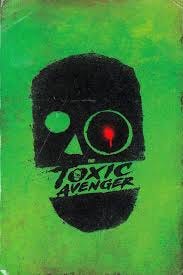
The superhero origin story of a janitor’s accidental exposure to hazardous waste became a cult classic in 1984’s The Toxic Avenger. “Toxie” doesn’t play the victim, instead he fights evil, saves people, and brings everyone a better quality of life. Although many films have an underdog premise, Hollywood studios themselves have long held a reputation for affluence, greed, and a general disregard for the average person’s problems.
Not so for 2025’s The Toxic Avenger reboot/remake. Bloody Disgusting reported that the film would erase at least $5 million in medical debt. Cineverse teamed up with the non-profit Undue Medical Debt donating a portion of the marketing budget and profits from the theatrical run. Incredibly, “The nonprofit leverages donations to purchase qualifying medical debt…for pennies on the dollar meaning one dollar donated, on average, erases $100 of un-payable medical debt.”
(Side note: I’ve been reading the biblical book of Deuteronomy and was pleasantly surprised to find how much debt forgiveness and care for the immigrant God demands for societies.[xi]) Can you believe The Toxic Avenger’s philanthropic mentality?!
Sure, I’m angered and frustrated by the broken American healthcare system that would even necessitate the existence of medical debt-relief foundations. But I’ll also accept the empowerment, grab my optimism-soaked mop, and support organizations like Undue Medical Debt. As we’ll see in a second, everything we do is a vote. Personally, I choose to vote for films like The Toxic Avenger which actually improve the real world.
In addition to solutions like the aforementioned disempowering limitation of greed and supporting charitable organizations, there is a spiritual aspect to consider. You may have noticed I mentioned “love” and “humility” several times through this article. I’ll give a more detailed personal account on these in the conclusion, but for now, consider love and humility as necessary to stop obsessing over ourselves and to seek the betterment of our communities.
Discussing a recent drop in American trust for other people, O. Alan Noble says:
“And yet, we are told two things in Scripture that challenge this low-trust assumption. First, we are called to love our neighbors as ourselves (Mark 12:31). And second we are told that part of the description of love involves hoping all things (1 Corinthians 13:7). Together, I believe these verses call us to a position of prudent and hopeful trust toward our neighbor, even strangers. And that this kind of trust is critical for building a functional society.”
Granted, this communal trust is perilous, especially if your neighbor is Tiger King’s Joe “I’ll-never-financially-recover” Exotic. But I think there’s a way to mitigate the risk: be intentional when you vote for leaders. And, no, we don’t just vote for politicians.
An Atmosphere of Character
Every day we cast our ballot in multiple arenas. The videos, podcasts, movies, and shows we consume are tallied as votes both by the hosting platforms and production houses. When you discuss the leadership of your work or church with others, you’re swinging public opinion. When we shop online, when we fill out an engagement form or take a survey, when we…you get the idea.
But what I’ve learned over the last five years is that my primary voting criteria, regardless of arena, should be centered around other people’s character of humility. To reiterate, as we think about the greed that fueled the ’80s (and has continued intergenerationally), we’re left thinking about leadership. The billionaires who inherited their millions, the CEOs and politicians, and, unfortunately, the pastors and priests. So what exactly is missing from greedy and scandal-ridden leader’s lives?
Taylor Jenkins Reid’s 2025 novel Atmosphere is a retrospective on women at NASA in the mid-eighties. Hero Joan Goodwin’s arduous journey of becoming an astronaut is compelling. Recounting a story from her youth when she didn’t want to help someone because it might make them smarter than her, she recalls: “…my mom said that if I was going to be proud of myself for being generous, that I had to do it even when it meant I might lose something. She said, ‘You have to have something on the line, for it to be called character.’”
Hours after reading those words about character, I received a subscription email from author and psychiatrist Chuck DeGroat entitled “Character Matters: Why I’ve Started Talking More About Character Than Health.” DeGroat explains that when he was a new pastor and therapist he unknowingly shifted from talking about character to “speaking in terms of health—the language we’d use in therapy.”
He elaborates that health is important, but the word has been co-opted; whereas character is important in psychoanalysis and ancient traditions. “Character, as I understand it, is who you are over time—revealed in your consistent habits and quiet choices, formed beneath the surface and beyond the whims of circumstance.”
That definition should cause us to slow down and self-evaluate. If we’re willing to take the time to honestly evaluate how our character performs over decades, we may become discouraged. But I think the bar only seems to be set high while we’re laying on our therapist-pastor’s couch.
Coincidentally, Chuck DeGroat seems to be the type of therapist-pastor that Daredevil and I need.
As such, I find DeGroat’s further thoughts helpful: “If personality is how we’ve learned to be seen, character is who we are when no one is looking—the hidden architecture of integrity, conviction, and care that shapes our consistent choices…Health can begin to improve in the short term. Character is forged slowly—measured not in weeks, but in years. Sometimes decades.”
As I prepared the retrospective about 2020 for the actual 1985 vs. 2025 article (which didn’t make it in but you just finished reading), I read Chuck DeGroat’s 2020 book When Narcissism Comes to Church, and was shocked to peruse the following words:
“I am convinced that the mission fervor and rise in church planting we’ve witnessed since the 1980s can be correlated with the growing prevalence of narcissism. Nowhere have I seen the narcissism-shame dynamic more pronounced than among church planters, some of whom have become megachurch pastors. Some church planting assessments I’ve seen practically invite narcissistic leadership. My work in this area as a therapist, pastor, consultant, psychological assessor, and professor over many years persuades me that the narcissism in many young men in particular is baptized as spiritual giftedness in a way that does a great disservice to them and ignores deep wells of shame and fragility lurking within. If Lasch is right and narcissism is the ‘longing to be freed from longing,’ then each subsequent generation has found yet a new way to distance itself from its humanity, from its limitations.”
Embracing our limitations can unlock hidden strength and be freeing. Easier said than done, right? And yet, I’ve been growing in awe of an all-powerful God who behaves humbly (not making us robots, the incarnation, dying for our rebellion against Him, etc.).
If I had a dollar every time God lead by example…
Conclusion: Deciphering via the Divine
I don’t have airtight answers to the tough questions like why does God allow suffering and does He actually punish people? Like everyone, my family and I struggled through the pandemic. On top of feeling alone and fearful and uncertain, we were forced to live in three different places over the course of 12 months (see my article here). We dealt with major health concerns, debilitating anxiety, and left the church we’d served in for 25 years.
But through it all, God blessed and taught us. For example, watching The Pitt, Doctor Robby’s panic attacks (in 2020 and 2025) reminded me of how God used Ted Lasso’s panic attacks to help me heal (as I wrote about here).
I’d always believed that God was equal parts justice and mercy, both loving and wrathful, simultaneously our propitiation and perfectly holy…like God, the list goes on and on. But then I learned that although God is just and impartial, there is one attribute greater than all the others. It is His loving mercy.
I heard this from Pastor John Mark Comer:
“In Jesus we see that Yahweh’s [i.e. God’s] anger is born out of his love… That’s why Yahweh’s love is an attribute, but his wrath isn’t. The Scriptures teach that ‘God is love,’ but we never read ‘God is wrath.’ Wrath, or anger, is Yahweh’s response to evil in the world.”
So when God created humans, He gave them a perfect world and explained not to disobey Him. God didn’t create robots, instead He gave free will because without choice, there can be no love. This introduced the possibility of disobedience and making bad decisions, but such is God’s unflinching, loving mercy - He gives choice.
Apologies if you were only looking for shallow pop culture or a quick historical comparison here. But this deeper look - God’s plan - is the only thing I’ve found to beneficially tie everything together.
Obviously, I think we can use the Satanic Panic and 2020’s Satanic Pan(dem)ic (yes, I had to fit that in somewhere!) to learn lessons. And yet, seeing historical events through the lens of God’s design has also helped me. But, as our corporate overlords are fond of asking, “Is the juice worth the squeeze?”
My vote is yes…maybe as we sit on the couch of a therapist-pastor – it’ll get crowded with you, me, and Daredevil, but it’s worth the risk.
[i] Noah Caldwell, Ari Shapiro, Patrick Jarenwattananon, and Mia Venkat.
[ii] “Devil and the Deep Blue Sea” podcast, Christianity Today (CT Media), Episode 8, 1:35:07.
[iii] “Devil and the Deep Blue Sea” podcast, Christianity Today (CT Media), Episode 6, 33:45.
[iv] University of Mary Washington, Talley Center for Counseling Services: Sexual Assault - Statistics, https://students.umw.edu/counseling/sexual-assault-information/statistics/. Additional information to this finding is that “1 in 33 men” in the USA have also “been victims of rape or attempted rape.”
[v] https://rainn.org/facts-statistics-the-scope-of-the-problem/statistics-the-criminal-justice-system/
[vi] Black, M.C. et al. The National Intimate Partner and Sexual Violence Survey (NISVS): 2010 Summary Report, 2011. The link (here) was no longer available on the CDC website as of the time of this writing.
[vii] Good was murdered on January 7, 2026.
[viii] According to The New York Times’ “The Morning,” 1/14/26.
[ix] Darrell Robinson, Total Church Life, B & H Pub Group, 1985, pp. 7, 14-15, 16.
[x] Biff isn’t rehabilitated into a productive, humble yet confident member of society He becomes instead a whiny, sniveling suck-up who only cares what George thinks. Couldn’t there be something in between bully and bondsman?
[xi] Examples include Deuteronomy chapter 15, 23:19-20, chapter 24, etc.