

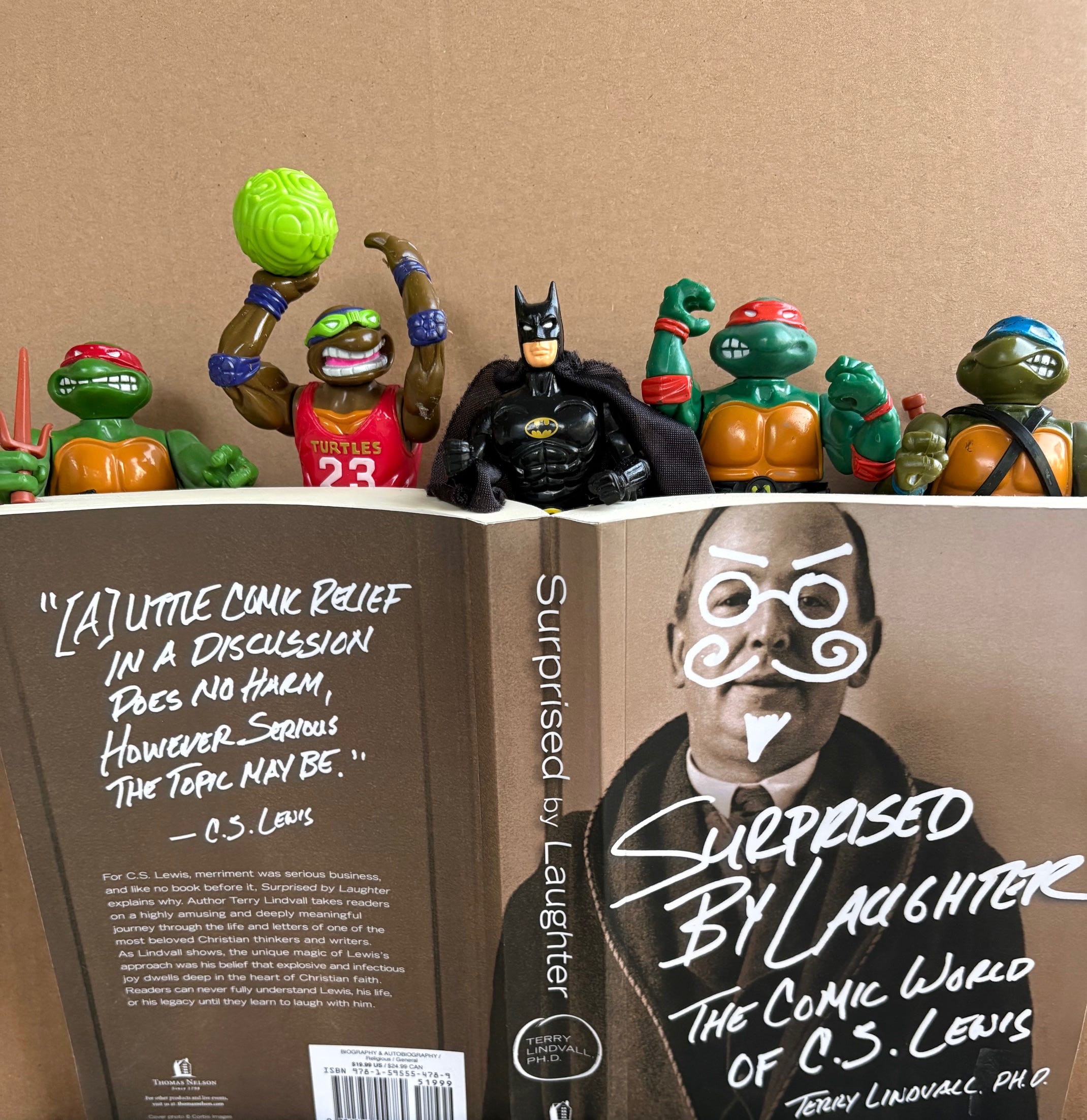
As an only child, I played alone a lot. In 1989 I got the special Batman figure with a repelling belt for my birthday. It was, of course, the year of Tim Burton’s breathtaking Batman, which, uncharacteristically, I was allowed to watch at my friend Justin’s sleepover. Inspired, I spent hours building a Batcave out of cardboard.
I also played with my Teenage Mutant Ninja Turtles figures, most often with friends. Travis and I explored my scaled sewers; Uriah loved using my turtle van (the “Party Wagon,” for you uncultured Bebops). I had an epiphany as I wrote this: It was apt for me to play alone with the solo vigilante, while playing in community with a shellular family.[i]
As I mentioned in my second creativity article, the ability to play is foundational to our originality. Dr. Terry Lindvall’s book Surprised by Laughter explores C.S. Lewis’ theory that life, and especially the Christian faith, is seriously humorous. In this addition of our creativity series, we’ll explore both that seriousness and humor as it unlocks fulfillment in our lives and creative processes.
Playing to Lose Oneself: Golfers with Revolvers
Shockingly, as probably history’s most well-known thinker who also brought fun and humor,[ii] C.S. Lewis had horrible experiences with games in childhood. He loved to play (in the general sense of the word - losing yourself to a fun endeavor) but lacked skill or the body type to do well in sports. He describes the situation as such:
“If the reader will picture himself, unarmed, shut up for thirteen weeks on end, night and day, in a society of fanatical golfers - or, if he is a golfer himself, let him substitute fishermen, theosophists, bimetallists, Baconians, or German undergraduates with a taste for autobiography - who all carry revolvers and will probably shoot him if he ever seems to lose interest in their conversation, he will have an idea of my school life… For games (and gallantry) were the only subjects, and I cared for neither. But I must seem to care for both, for a boy goes to a Public School precisely to be made a normal, sensible boy - a good mixer - to be taken out of himself; and eccentricity is severely penalized.”[iii]
What a solemn, sad, and possibly very relatable experience. And yet, his description leaves me in impressed awe. Only Clive Staples (or “C.S.” to his closest strangers) could use a descriptor so horrifying, yet so hilarious as “who all carry revolvers, and will probably shoot him.” Then he brings it home (sorry to use an idiomatic phrasal verb for a baseball game) replacing “golfers” with apparent monsters like “bimetallists” (i.e. advocates of using two metals as a currency standard) and “German undergraduates,” to which he hilariously must add “with a taste for autobiography.”
Contrary to what we’ve been taught (or might think), humor doesn’t undermine the story’s severity, it strengthens Lewis’ point because he gives us permission to laugh at a tense situation. Scholar Peter Berger says “that when we surrender to our play and let it remain simply that, we encounter a ‘signal of transcendence.’” Adding commentary, Lindvall reminds us of instances when we played and lost track of time. “Play gives us a taste of eternal joy in the midst of the momentary…To be alive and to be laughing is itself an adventure and a game created by a miracle of God – a miracle that is beyond our comprehension.”[iv]
So play and games and humor aren’t just integral to our creative life, but to life itself. And this isn’t a prosperity doctrine or pseudo-spiritualism tenant, it actually addresses head on the brokenness of our world.
Earth: A Painful Playground
We all go through pain, some much more than others. It’s easy to become hopeless from the tragedies and injustices inflicted daily.
Lewis knew about heartbreak and suffering (after all, he wrote The Problem of Pain), but he realized that God doesn’t give us unlimited happiness, or an IV drip of perpetual joy for a good reason. God created us to take pleasure in Him and the things He created.
Therefore, when we subvert God or what He has created, it stands to reason that He will not allow us to experience perfect joy. God created the chemicals in our bodies to experience emotions in a natural way, but when we snort cocaine to achieve a similar high, He’s not going to bless that because it will ultimately hurt us. Or, sticking with our “play” theme, Lewis (and his spiritual predecessor, G.K. Chesterton) believed once games and sports were elevated to the professional level, they were drained of all fun and whimsy and true creativity.[v]
In His goodness God gives us play and laughter and moments of joy to remind us of heaven, but in His wisdom He doesn’t give us unfettered joy, so that we don’t get too comfortable here on earth. Every ache at injustice or sigh at mundane normality is a God-infused longing for the joy of perfection.

Solempne Sterling
It shouldn’t surprise us then that solemn subjects like pain should be coupled with play and humor. I love Sterling K. Brown’s turn as a murder suspect on Brooklyn Nine-Nine’s episode “The Box.” Both Andre Braugher and Andy Samburg shine, but it is Brown who elevates the bottle episode to one of my favorites. Brown’s character – a dentist who may have killed his business parter – is self-assured, calm, and above all, serious.
It takes an exceptional actor to convey solemnity while delivering (and setting up) comedy gold. But this is actually a trait every human should possess…not the ability to play the straight man (although I hear there’s an opening for Bud Abbott’s spot). Every person should know they have permission to find humor in solemn situations.
C.S. Lewis revealed a little known fact: One of the many gaps in the English language is that we lost the word “solempne” (soh-LEM-neh) from Middle English. The word is similar to “solemn” but not “gloomy, oppressive, or austere.” Instead, it allows for joy and proper pleasure. Lewis gives examples: A fast is solemn, a feast is solempne. Good Friday is solemn, Easter (or what I call Resurrection Day) is solempne.[vi]
This was a revelation for me. In our daily lives as well as our creativity, although not necessarily socially acceptable, it is okay to accidentally laugh at an impertinent time, it is healthy to release tension with a joke. This allows us to feel the burden of pain and the weight of respect, while interjecting joy at what might be its most needed time.
How might we see this played out creatively? Brooklyn Nine-Nine’s writers (né creatives) infuse much needed tension into the aforementioned episode by giving the detectives only a few hours in the middle of the night to get a confession out of Sterling K. Brown. And that premise is a hallmark that makes Brooklyn Nine-Nine so enjoyable – serious people and topics intertwined with hilarity.
Bullies and Batcaves
For creatives to play even in the midst of pain can seem impossibly insurmountable. But we must remember play “gives us a taste of eternal joy” in the midst of brokenness. And true creation never destroys, it may remodel, but ultimately it is a positive force.
Take hope from Lewis who hated organized sports in school but retained a passion for play. One of the most haunting phrases from his golfers with revolvers memory is “eccentricity is severely penalized.” I’ve been bullied and mocked (imagine being bald, bearded, tattooed, and weird like me…in third grade) on and off throughout my life. Trust me, building cardboard Batcaves and sewers and Party Wagons wasn’t cool (to the cool kids).
Unfortunately, some of the weird creative was beaten out of me and some was siphoned off (through the unbearable weight of adulthood). So don’t hear this as: “Just follow your dreams.” I’m no motivational speaker, I’m no creative hero, but maybe, like Tina Turner heralded, “We don’t need another hero.”
Instead let’s pragmatically focus on what we can control. Maybe whether we built cardboard Batcaves as kids or not, what matters is that we accept permission to play now. How much better and free-flowing will our creativity be if we are free to let humor and joy break up the seriousness? Don’t forget solempne’s lesson of respecting the solemn while injecting joy. Oh, and consider building a cardboard Batcave, but don’t feel pressured into a Party Wagon – I don’t think you’re ready for that yet.
[i] Am I the first to use a play on words for the phrase “cellular family” regarding the Turtles?
[ii] Or maybe Mark Twain?
[iii] C.S. Lewis, Surprised by Joy, p. 80; quoted by Lindvall, Surprised by Laughter, p. 165.
[iv] Lindvall, Surprised by Laughter, p. 166.
[v] ibid, pp. 164-166.
[vi] ibid, pp. 86-87.